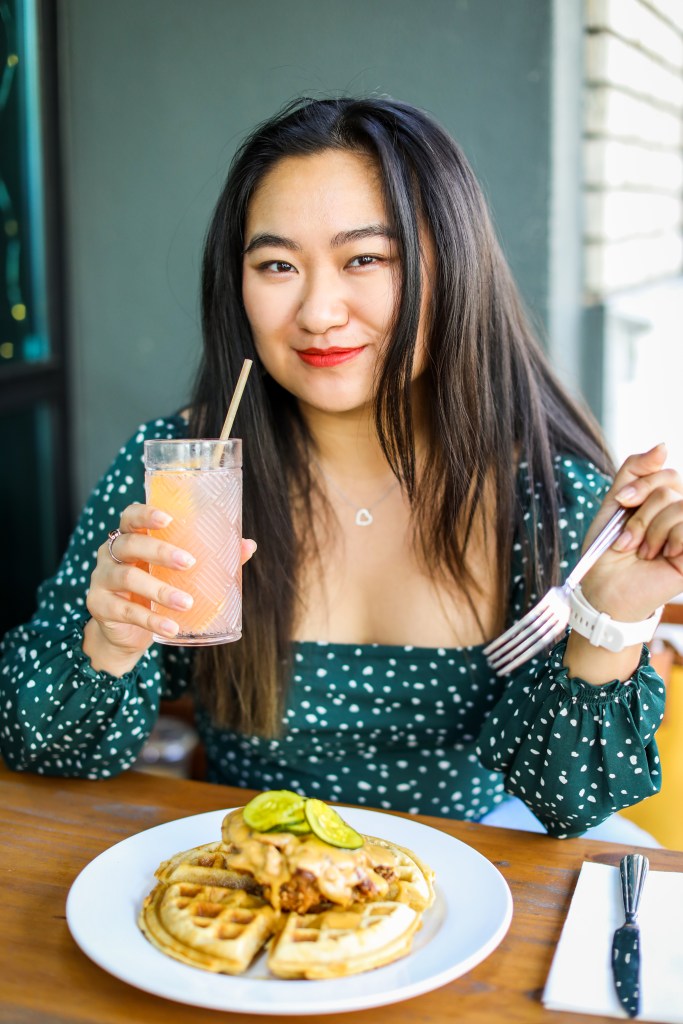
This week, I had the privilege to interview Em Chan, food and dining reporter at the Statesman Journal. The Statesman Journal is the major daily newspaper published in Salem, Oregon. I connected with Em after hearing her talk at the SOJC’s THRIVE! career inspiration panel in January 2023. I loved hearing her honesty about experiences in the communications field, and her pipe dream to write about food. Em was the perfect person to provide insights about food journalism and the industry itself.
Here is my interview with Em!
This interview has been edited for length and clarity.
Interview
Q: Can you tell me about how you started your food blog?
A: The iteration you see online now was not the first iteration, it was my second. I initially wanted to write about food, it’s been an interest of mine ever since I was younger. The thing was, I never thought about what kind of platform I wanted. No one told me you can make the internet your place, how you can do this and that. All I knew was that people are on TV and have talk shows. But when I saw that I could make a free blog, I thought you know, why the heck not. When I started blogging, I didn’t have an idea of what I would do. Some of the content you see now, and honestly I should go back and clean it up, it’s a mix of personal writing, restaurant review-esque writings, lists and my opinions on food. When I got started, I was just in the mindset of “Oh I just wanna share my thoughts,”. As I got more into it, it became oh maybe I should talk about myself, or what if I shared this or that about food. I think it became pivoted more towards myself as a lot of the content went on.
Q: In your opinion, what role does food play in shaping culture and community?
A: For most cultures, food is essential to creating community and fostering relationships. Everyone needs food, and the best way to connect with people is over a meal. So for me, I’m Chinese, so I was raised having lots of family meals, big meals, family style and that’s the time we can talk and reconnect for the day. Especially as I live by myself now, away from my family, I think very fondly of how that time was very precious to me. Of course I still see them, but it’s just not the same. In general community, as anyone that goes out to a new town, settles into a new place, making new friends, acquaintances – the very same way I connect with my family, I connect with the people that I meet out here. Especially in my role as a food writer, my blog is what launched my food writing career. So now, I do this very same thing but with restaurant owners, cooks, and wait staff with different dynamics. Having food as the starting point for a lot of relationships is a lot easier not just that everyone needs food, but just so everyone can meet each other at that place even in different circumstances and regards.
Q: What inspired you to pursue a career in food journalism?
A: My parents said no initially to any of my attempts to be a writer. I should start with that. I have always admired food content when I grew up on the Food Network. A lot of people will say that food media was very impactful, and I am one of them as well. I would say I’ve always loved writing and I grew up writing fiction. I always did well writing essays and reports, but nothing had clicked for me. It wasn’t until I started my blog that people were saying I should share my food opinions. Then, that led to an Instagram and to joining the paper because one of my best friends at the time worked at the Emerald. He said, you know you might as well have a real platform if you ever want to take this somewhere. At the time, I was studying public relations and advertising. I didn’t have an opinion like “Oh this is gonna be my life,” because like I had mentioned at the top of this, my parents did not want me to be a writer. They wanted me in something a little more stable. So once the opportunity came around with the student paper that I could make this something of my own, I thought why not. Why not take the chance. If all else fails I’ll think about this a half step higher than my own blogging. Fortunately, things worked out for me that I could get the role that I have now and I have literally my dream job.
Q: How do you stay updated on the latest food trends and dining experiences?
A: My role is a little funny – I’m not a reviewer, not a restauranteur. My role is specifically food and dining reporter. I write the news of what is going on in my community, which in my role is Marion and Polk County. I recently did a stint last year with The Register Guard, so I was covering Lane County, but I’ve returned to simply covering Marion and Polk County. The funny thing about this area is it’s not nearly as modern and with the new trends as Portland is. I report on what’s happening down here, whether it’s an opening, a closing, people doing interesting things, people holding festivals, and whatnot. A lot of that is perusing the internet. Facebook is my best friend. I hate it so much, but everyone loves Facebook around here. I also crawl Instagram and I spend a lot of time on the road. The funny thing about small towns is that yeah the internet exists, but a lot of them still really love putting up flyers in their hometown. Besides being on the internet I’m also driving around these small towns talking to local owners, catching up, and asking questions all the time. It is a lot less glamorous in that way. Hopefully, it doesn’t disappoint too much that it’s not too crazy. It’s just me, my car, and scrolling social media for my job.
Q: Can you share any memorable experiences or stories from your time covering the food and dining scene?
A: I did not know anything about wine blending. I got this press release about this winery. They’re doing Pinot Noirs, they got these big old barrel contraptions with a faucet head. You could change how much wine percentage you’re gonna add into your glass or bottle and come up with this custom blend of Pinot Noir. I just thought to myself, that’s really weird. Again, I didn’t have a lot of experience with wine. But what I’ve learned for this assignment, and mind you this was 2021 so I was still very fresh – this winery was one of the first to begin the wine country that we now know within the Willamette Valley. This experience is trendy as it’s kind of new. Not new for the general world of wine because plenty of places in Europe do wine blending, but it was sort of new here where you could customize your wine blends. The Willamette Valley is well-known for Pinot Noir and other wine varietals are dictated by the clone of grapes. The variation within the species of grapes. So I learned all about the various species, how they came over here, the legislation that they had to pitch to bring these grapes, and kind of start the Willamette Valley as a wine country as we know it way back then. I got to try all these wines and like you, I’m not gonna drink a lot of wine. That’s not the first thing you think to drink once you turn 21, you start with a lot lighter stuff, more fruity. I was trying all these wines and I was thinking to myself – “What exactly am I tasting? What is the difference?” I’m trying to write about this experience, again very little wine background. It was just fun to see all this newer technology in the Willamette Valley and to have this new experience I would have never thought to, or would’ve been exposed to had I not been in my role. As one of my first experiences on the job, it opened my eyes to the fact people think Salem, Marion, and Polk County are very boring, but there’s a lot here. It’s just a matter of if people are willing to stick their noses and commit to finding what is extremely interesting and fun about this region.
Q: How do you think the COVID-19 pandemic has impacted the food and dining industry, and how has it affected your reporting?
A: I feel like it spun the world on its head. I do not think there is a world in which how we have held the expectations of food, dining, and service. It will never return to how it was before. It revealed a lot of entitlement in people. A lot of inefficient and grueling systems within our labor, manufacturing, ingredient procurement, food making, how we see and value service, and what that means to culture and society. Within my own reporting, I was not reporting at the paper I’m currently at now, I was still a student. At the time when I was a student, reporting was challenging because there was not a lot of hope and certainty about anything. You saw the rise of a lot more food trucks, and take-out. There was ingenuity in trying to create experiences for people who were not around typical service where you sit at a table and eat. So a lot of outdoor things, pseudo take-out, pop-ups. When I moved into my role here, there was still a lot of fraught energy with people “deciding” if being masked was worthwhile, if the pandemic was “over”, and trying to write about those dynamics was really challenging. It’s a very contentious topic and I think people to this day still argue about whether the pandemics over, whether we should still be masked, whether there should be more health precautions in place. A lot of my role in the beginning was providing these updates on dining – are we allowed outside dining, what kind of outside dining, indoor dining, the capacity. A lot of restaurants were shifting to returning to indoor dining, or they were shutting down because they couldn’t get to the point of indoor dining fast enough. One of the things that really got to me was simply how the actual service itself has changed. So I wrote a lot about how there’s not enough workers, people are struggling to hire, or people are saying no one’s hiring them even though they aren’t applying. So those back and forth exposes of all the holes within salaries, wages, and service. You go to a restaurant, you see 3 people, and the restaurant’s full. Is that really how many people should be working? No, it should be 5 or 6. They should not be struggling, and wait times for food shouldn’t be over half an hour. Just balancing all these questions and dynamics are really what I think is why the industry won’t be able to return to a place as it was before. Back then we simply brushed it under the rug, we knew with “certainty” that nothing would change. But now, we’ve seen the devastation of people’s livelihoods, people realizing they don’t want to live that way. They can take a stand and push for other options and alternatives in that system, even if that means leaving it entirely. Right now as it stands, I think we are coming to return to form in a way more restaurants being open, food carts, people doing other activities, and fundraising almost at the same levels as before the pandemic. But, it’s not quite there yet.
Q: How do you see the future of food journalism evolving as well as the industry as a whole?
A: Food journalism, it’s hard to say. I think we are at a tumultuous time in a lot of publications are not valuing food reporters. At the same time journalists, true journalists held to an ethical standard are battling in the face of influencers, online foodies who are not held to an ethical standard. They are currently being chased by the Federal Trade Commission to make sure that if they are to move forward as people who are going to make money doing food and things of that nature online, that they do it and are held to an ethical standard. Right now, it’s the wild, wild, West on the internet. I think because of the diminishing number of people within journalist roles or are held by, for lack of a better phrase, the former gatekeepers of this industry in food journalism with papers and publications. With fewer of those, there’s a rise of the regular guy. The regular guy is great, however, again to that ethical standpoint, journalism and bloggers are different. Bloggers can be within, and influencers can be held within the blogger space. In my mind, I detest influencers to a degree because there are so many that are not moving ethically. On the other hand, I think the industry as a whole, in food, not just journalism but a general food industry – I think we’re moving to a better place. We’re having a lot of important conversations with how we talk about diversity, labor, and sustainability. Having a higher general interest in making sure those are more ethical and sustainable and a good place to be, especially with the downfall we saw with people leaving industry when the pandemic shut all restaurants and in-house service down. I’m hopeful, tentatively, because I’m a very jaded person. But here’s to hoping.
Q: Can you share any tips for readers on finding hidden culinary gems in their area?
A: Whenever you go somewhere new, whether you are very familiar, whether you’re not very familiar, whether you’ve been there a lot – maybe it doesn’t even have to be new. You can take away the fact that it’s new. If you go anywhere and you wanna have new food, I think there’s 3 important rules to have. These are my rules.
1) Realistically, what can you find and what can you not find out here. For example, I’m not gonna go to the Midwest and try to find clam chowder. That’s not realistic. Wherever you go, I think you should have those expectations in mind, and you should not go anywhere that seems like a total far cry from what realistically will be good. Like in the valley, you can find a lot of great produce, beef, chicken, and pork. I don’t know I would stay away from some seafood, maybe like more exotic seafood.
2) I think a lot of people have this idea that authentic food is the only good food, or that you know fusion is the best, or some idea of what that is. If you’re gonna look up authentic food, fine, not all foods made are made for the same reasons. The reason why there’s American Chinese food is because back then, there was a lack of access to those traditional ingredients. To be able to keep up a living, they have to tailor the food so people will eat it. So when entering a place with a specific concept, think about whether that concept was for you, for others, the prime demographic. Because yeah, the food could be good and you might not like the style or vice versa. The style might be good to some people, but just not for you. So before critiquing why a place might offer what it does, to just think a little harder as to why that might be.
And lastly, just because a place has really high ratings online, literally, excuse my language, means jack sh*t. Because yeah a lot of people can go to the same place and like it, but I think to only judge a restaurant by how well the ratings are is a really flawed way to think about your dining experience. Because if you only go to the ‘best’ places, a lot of those places are really good because they’re offering something that a majority of people will like. So if you really want to get something good, you’re gonna have to go out of the box and sometimes take a chance. And so to not simply depend on the reviews you see online, because a lot of those can be manufactured, bought, and highly persuaded. So to just take a chance, and if you don’t want to take a chance, ask a local. Like, “Hey, if I want to try something that’s really unique to the area, what should I try?”. I would trust someone local in-person that i’m asking more so than a review online sometimes. So yeah, those are the three things i’d keep in mind.
Wrapping Up
Chan’s experience with food writing began with her personal blog, Sik Fan Meh Ah?, and now she is a reporter with one of Oregon’s major newspapers. Her work in food writing continues to grow with the industry.
The next time you have a meal, I encourage you to think about how food plays a role in your culture and community.
To read Chan’s works, click here!
Featured Image from WordPress AI
 Bianca Genevie Abello
Leave a comment